So, I was checking out some user reviews for the "V For Vendetta" DVD on Amazon yesterday and a particularly goofy one from a fella by the name of Ronnie Clay from Louisiana caught my eye. I went on to look at all the guy's reviews. They turned out to be a treasure trove of laughs. The cream of the crop follows:
Monday, July 24, 2006
Ronnie Clay: More Prophit (sic) Then (sic) Critic


Wednesday, July 19, 2006
Trapper Keeper
Keep this little quote in the back or your head as you listen to the various idealogues spout their psyche-fuck "facts" 'round the media spectrum this week. Manipulation is as thick in the air lately as it's ever been. (For example as in Fox News' coverage of the ongoing chaos between Israel and Lebanon, every headline and every talking head insert the caveat of Iranian bogeyman behind every Lebanese act or utterance... Which for anyone who's done their homework, is clearly a gross obfuscation--if not downright fabrication--of events.)
"Of course the people don't want war. But after all, it's the leaders of the country who determine the policy, and it's always a simple matter to drag the people along whether it's a democracy, a fascist dictatorship, or a parliament, or a communist dictatorship. Voice or no voice, the people can always be brought to the bidding of the leaders. That is easy. All you have to do is tell them they are being attacked, and denounce the pacifists for lack of patriotism, and exposing the country to greater danger." -- Herman Goering at the Nuremberg trials.
"Of course the people don't want war. But after all, it's the leaders of the country who determine the policy, and it's always a simple matter to drag the people along whether it's a democracy, a fascist dictatorship, or a parliament, or a communist dictatorship. Voice or no voice, the people can always be brought to the bidding of the leaders. That is easy. All you have to do is tell them they are being attacked, and denounce the pacifists for lack of patriotism, and exposing the country to greater danger." -- Herman Goering at the Nuremberg trials.
Tuesday, July 18, 2006
Bush and the G8: A Comedy of Manners
Really, is it just me or does anyone else think that the rotted corpse of Rodney Dangerfield would make a better president of the US?
First there's open mike night.
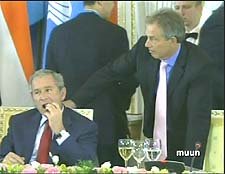
And then it's Han Solo you can't see what they're doing.

There's more overtly political diggin' here and here and here and here. But I think that commenter HereinDC puts it best on the C&L messageboard: He chews with his mouth open. Talks with food in his mouth. Inapproiately touches women.Curses. All in a span of 4 days. Is he off his meds?Drinking again?
Anyway, here's some video of a very classy guy with some very deep thoughts:
Monday, July 17, 2006
The Ol' Reacharound
Glenn Greenwald has the goods on the latest Neocon sleight of hand—namely the attempts to posit the Israeli’s war as “our war.” PNAC co-architect and salivating imperialist, Bill Kristol, appeared on, of course, Fox News this weekend practically coked to the gills with lust for what a definitive showdown in the Middle East might mean for Israeli American aspirations in the region. Greenwald goes on to discuss one of the most important yet taboo-laden topics in American (and thus global) politics today, “the effect of the domestic Israeli lobby on U.S. foreign policy.” His run-down begins with a nod to an article by Glen Frankel in this weekend’s Washington Post, titled, A Beautiful Friendship? In search of the truth about the Israel lobby's influence on Washington. It’s meaty, uncomfortable reading, but you can take it. Get in there.
Friday, July 14, 2006







Thursday, July 13, 2006
Is This What Democracy Looks Like?
"Jose Villa was videoing LAPD during the anti-Minutemen protest called by ANSWER LA last Saturday. As the YourTube video shows, he and Christen Westberry were standing still when an LAPD officer on a bicycle stopped next to them, picked up his bike, slammed it into them, pushing them into other police who then clubbed until they were lying on the pavement - then continued beating them."
This Is What Democracy Looks Like
With the recent Mexican presidential election looking entirely too much like Florida ’00 and Ohio ’04, the shit has really begun to hit the fan. Like Florida and Ohio, there has been plenty of evidence of nefarious goings-on but unlike the US citizenry’s mostly limp responses, the Mexican public is poised to halt the process and demand a thorough investigation of both the election results and the multitude of fraud allegations.
While it may seem that Mexico’s a world away, it’s important to note that their young democracy is indeed modeled after our own—except Mexico's citizens seem to have a better grasp on what it means to live in a democracy than many in the US. In any event, there’s nothing like having a mirror around to see how good or bad you look.
Thusly, here’s Al Giordano’s three part series documenting the ongoing battle by Mexico’s citizenry and Left-leaning politicos to halt the coronation process and go over the voting results very, very carefully. (A shocking idea, I know.)
There’s plenty of background in these articles for those who, like me, haven’t kept too abreast of the players. There’s also a focus on individual accounts that help to illustrate the concerted effort to rig the election. It’s all a bit of a meaty read, and it gets a little depressing and a little too familiar. But because of the refusal of the Mexican left to simply accept the corrupt results—the refusal to just lie down and die—the story ultimately becomes an exciting inspiration. Read ‘em while they’re hot:
Part 1: In Mexico, 2.5 Million Missing Votes Reappear: López Obrador Reduces Calderón’s Official Margin to 0.6 percent IFE’s Claim that 98.5 Percent of Votes Had Been Counted Was False: Authorities Now Oppose Recount
Part 2: A Full Recount Would Show that López Obrador Won Mexico’s Presidency by More than One Million Votes - The Tip of the Iceberg of the Crimes Committed by Mexican Electoral Authorities Is the Fraudulent Vote Count of 2006
Part 3: Death by Video: Mexico’s Election Fraud Is Coming Undone - Video and Audio Evidence, an Outraged Citizenry, and Panic from the White House Are Converging to Make López Obrador the Next Mexican President
While it may seem that Mexico’s a world away, it’s important to note that their young democracy is indeed modeled after our own—except Mexico's citizens seem to have a better grasp on what it means to live in a democracy than many in the US. In any event, there’s nothing like having a mirror around to see how good or bad you look.
Thusly, here’s Al Giordano’s three part series documenting the ongoing battle by Mexico’s citizenry and Left-leaning politicos to halt the coronation process and go over the voting results very, very carefully. (A shocking idea, I know.)
There’s plenty of background in these articles for those who, like me, haven’t kept too abreast of the players. There’s also a focus on individual accounts that help to illustrate the concerted effort to rig the election. It’s all a bit of a meaty read, and it gets a little depressing and a little too familiar. But because of the refusal of the Mexican left to simply accept the corrupt results—the refusal to just lie down and die—the story ultimately becomes an exciting inspiration. Read ‘em while they’re hot:
Part 1: In Mexico, 2.5 Million Missing Votes Reappear: López Obrador Reduces Calderón’s Official Margin to 0.6 percent IFE’s Claim that 98.5 Percent of Votes Had Been Counted Was False: Authorities Now Oppose Recount
Part 2: A Full Recount Would Show that López Obrador Won Mexico’s Presidency by More than One Million Votes - The Tip of the Iceberg of the Crimes Committed by Mexican Electoral Authorities Is the Fraudulent Vote Count of 2006
Part 3: Death by Video: Mexico’s Election Fraud Is Coming Undone - Video and Audio Evidence, an Outraged Citizenry, and Panic from the White House Are Converging to Make López Obrador the Next Mexican President
Wednesday, July 12, 2006
The 48 Laws of Power
Ahhh. So, young grasshopper, it is begun. May your training fare thee well.
(Via Cursor.org)
Tuesday, July 11, 2006
Through a Projector Poorly
While I’ve never been particularly hot for science fiction, I have in the last few years become pretty hot for the writing of Philip K. Dick. There’s something about his fast-moving prose and the brutal economy of wording that takes a little getting used to, but ultimately becomes as much a part of the story as the characters themselves.
No less jarring at first are the perception shifts that sometimes flip the reader’s perspective two, three, four or more times in the course of a novel. It can be a dizzying experience—especially when he ventures into the more esoteric aspects of the human experience. Often his narratives become more philosophy experiment than fantastic tales of some dystopian future. And while that irked much of Dick’s contemporary SF audience, (indeed his works were deemed with mild derision as “cult” science fiction) future audiences would lustily converge on his works from tastes across the literary spectrum.
Myself and plenty others are drawn to his stories because of their tendencies to play around, with and inside various fundamental frameworks of “reality.” They leave the reader dizzy, giddy, yet… wiser somehow. Similar to particular chemically or physiologically induced alterations of our perception of the universe, several of Dick’s novels leave the reader with a permanently, slightly altered view of the world around them and their place in it. It’s a remarkable feat for any literary work to achieve and certainly the mark of (yeah, it’s a bankrupt word, but it fits for once) genius.
So, of course I went to see director Richard Linklatter’s new interpretation of A Scanner Darkly the first chance I got. Discussion and reviews of the stars and the meanings and the method are all over the place right now. I couldn’t add much by spouting on anything there, so I'll just toss out a take on the film: It was lousy. I wanted to love it but I can’t even say I liked it.
Now, by way of disclosure I should say that I actually haven’t read that particular Philip K. Dick book, but since I’ve devoured plenty of his other works, I feel comfortable enough in saying that the book is a helluva lot better. Word has it that Linklatter stuck very closely to the arc and episodes of the novel. Perhaps that was the problem. The film was flat and, frankly, confusing.
The much-gabbed about Rotoscoping (painting-on-the-film) technique ultimately worked against the plot by distracting from the shifting perspectives, which needed more establishing, more grounding than they did when they were played out in words. (Though, truth be told, the effect it produced on the “scramble suits” was consistently, joyfully, mesmerizing.) Additionally, the actors were apparently instructed to be very faithful to the text. While this is admirable on paper, in practice it seemed to rob the production of much of its urgency. And in a film where the plot rides on an alternating current of urgency and philosophy, that means half the battle is lost before the cameras even roll.
There were parts I did like though. The story is genuinely intriguing and the particular take on the police state of the future is extremely relevant and urgently compelling—if only because it’s not exactly futuristic enough for comfort. But those elements don’t speak to the film itself, they're still of the story. And therein lies the problem. The production took plenty from the novel, but gave little to the story save the rotoscoping, which went from “neat” to “irritating” after about the first hour.
It’s when the elements of giving and taking are compared to other PKD film adaptations that we are witness to the great divide between the possibilities of literature and film. Each have their stengths, their weaknesses. Adaptations that pull off the translation well, rarely wring from the work more the its tranlatable elements. It's an art unto itself, really, knowing what to take and what to leave and just how much of each.
Sure. the well-liked adaptations like Blade Runner and Minority Report, hell, even the fun and goofy Total Recall, are all built upon the basic frame of the Dick story. But each eschew much of the bare-knuckle philosophy for more gunplay, more gore or more sex. These productions realized that, as a film, the essential elements of a Dick story need to be reversed in their proportions if they’re to succeed. Ease off the speculative philosophy and experiments in subjectivity and pump up the boobs, chases and explosions.
And there, in a handful of sentences, you have the formula—the how if not so much the why—of adapting a Philip K. Dick literary work for the screen. It’s also the reason A Scanner Darkly never exactly takes a flying leap and kicks our asses and our brains in the way it ought to. At least the way the book does… or so I expect it does.
Please note that I do believe that philosophy can and does work well in film... in the right hands and with the right material. My point here is that what makes PKD's more literary flights of intellectual fancy unique, exhilarating and even life-changing, are the very elements that remain impossible to successfully translate to film in a narrative capacity. Exactly why is the basis for another essay, I suppose.
No less jarring at first are the perception shifts that sometimes flip the reader’s perspective two, three, four or more times in the course of a novel. It can be a dizzying experience—especially when he ventures into the more esoteric aspects of the human experience. Often his narratives become more philosophy experiment than fantastic tales of some dystopian future. And while that irked much of Dick’s contemporary SF audience, (indeed his works were deemed with mild derision as “cult” science fiction) future audiences would lustily converge on his works from tastes across the literary spectrum.
Myself and plenty others are drawn to his stories because of their tendencies to play around, with and inside various fundamental frameworks of “reality.” They leave the reader dizzy, giddy, yet… wiser somehow. Similar to particular chemically or physiologically induced alterations of our perception of the universe, several of Dick’s novels leave the reader with a permanently, slightly altered view of the world around them and their place in it. It’s a remarkable feat for any literary work to achieve and certainly the mark of (yeah, it’s a bankrupt word, but it fits for once) genius.
So, of course I went to see director Richard Linklatter’s new interpretation of A Scanner Darkly the first chance I got. Discussion and reviews of the stars and the meanings and the method are all over the place right now. I couldn’t add much by spouting on anything there, so I'll just toss out a take on the film: It was lousy. I wanted to love it but I can’t even say I liked it.
Now, by way of disclosure I should say that I actually haven’t read that particular Philip K. Dick book, but since I’ve devoured plenty of his other works, I feel comfortable enough in saying that the book is a helluva lot better. Word has it that Linklatter stuck very closely to the arc and episodes of the novel. Perhaps that was the problem. The film was flat and, frankly, confusing.
The much-gabbed about Rotoscoping (painting-on-the-film) technique ultimately worked against the plot by distracting from the shifting perspectives, which needed more establishing, more grounding than they did when they were played out in words. (Though, truth be told, the effect it produced on the “scramble suits” was consistently, joyfully, mesmerizing.) Additionally, the actors were apparently instructed to be very faithful to the text. While this is admirable on paper, in practice it seemed to rob the production of much of its urgency. And in a film where the plot rides on an alternating current of urgency and philosophy, that means half the battle is lost before the cameras even roll.
There were parts I did like though. The story is genuinely intriguing and the particular take on the police state of the future is extremely relevant and urgently compelling—if only because it’s not exactly futuristic enough for comfort. But those elements don’t speak to the film itself, they're still of the story. And therein lies the problem. The production took plenty from the novel, but gave little to the story save the rotoscoping, which went from “neat” to “irritating” after about the first hour.
It’s when the elements of giving and taking are compared to other PKD film adaptations that we are witness to the great divide between the possibilities of literature and film. Each have their stengths, their weaknesses. Adaptations that pull off the translation well, rarely wring from the work more the its tranlatable elements. It's an art unto itself, really, knowing what to take and what to leave and just how much of each.
Sure. the well-liked adaptations like Blade Runner and Minority Report, hell, even the fun and goofy Total Recall, are all built upon the basic frame of the Dick story. But each eschew much of the bare-knuckle philosophy for more gunplay, more gore or more sex. These productions realized that, as a film, the essential elements of a Dick story need to be reversed in their proportions if they’re to succeed. Ease off the speculative philosophy and experiments in subjectivity and pump up the boobs, chases and explosions.
And there, in a handful of sentences, you have the formula—the how if not so much the why—of adapting a Philip K. Dick literary work for the screen. It’s also the reason A Scanner Darkly never exactly takes a flying leap and kicks our asses and our brains in the way it ought to. At least the way the book does… or so I expect it does.
Please note that I do believe that philosophy can and does work well in film... in the right hands and with the right material. My point here is that what makes PKD's more literary flights of intellectual fancy unique, exhilarating and even life-changing, are the very elements that remain impossible to successfully translate to film in a narrative capacity. Exactly why is the basis for another essay, I suppose.
Saturday, July 08, 2006
Tossin' Off in the Grand Ol' USA
The man who led America's hunt for Osama bin Laden has said the CIA was wrong to disband the only unit devoted entirely to the terrorist leader's pursuit - just at a time when al-Qaida is reasserting its influence over global jihad.
Read: Agent Who Led Bin Laden Hunt Criticises CIA
Then: Tell me the fix aint in
Read: Agent Who Led Bin Laden Hunt Criticises CIA
Then: Tell me the fix aint in
Friday, July 07, 2006
Phishing for Suspects an' Laughs
Wanted to post something about how in light of this new New York bomb plot thwarting and the puffy-chest, chicken strutting the Guv’s doing today, that we should all take time out from out busy, busy schedules to reflect. Yes. Reflect. Reflect all the way back to the last thwarted terrorist plot. All the way back to a couple weeks ago when the hapless crew from Miami was cold busted thinking about blowing up the Sears tower here in Chi-town. We should be reflecting on the fact that, as it turned out, the clowns involved in the “plot” were not only dumber than a bag of dog shit worn as a fashion accessory, but that these dopes were given the idea, the details and encouragement from the government informant who’d managed to “infiltrate” the group. The gang of evil masterminds apparently needed an extraordinary amount of goading to go from high-on-the-couch-at-2-AM, “man, you know what’d be a groovy idea,” to reluctantly agreeing to the spy’s demolition plan-- apparently only to get him to leave them alone.
And, yea, it appears they’d sworn some kinda oath to Bin Laden at some point. But after listening to their families and reading parts of their testimony, one is left with the feeling that the “oath” came with all the gravitas of a BFF handshake during the wee hours of a 7th grade sleepover.
So, I was gonna write a little bit about that, but I’m feelin’ a touch unpolitical today. So, instead, here’s a funny prank call from England. It’s via both the all-knowing, all-seeing Boing Boing and omniscient Digg, so of course, you’ve already had yr laugh at it. But just in case:
Some DJs played a trick on two Chinese restaurants. First they called one restaurant, placed an order, then called another restaurant and connected them to the first restaurant and asked the first restaurant to repeat the order to the second restaurant. The second restaurant thought the first restaurant was a customer placing an order.
Hear the call.
And, yea, it appears they’d sworn some kinda oath to Bin Laden at some point. But after listening to their families and reading parts of their testimony, one is left with the feeling that the “oath” came with all the gravitas of a BFF handshake during the wee hours of a 7th grade sleepover.
So, I was gonna write a little bit about that, but I’m feelin’ a touch unpolitical today. So, instead, here’s a funny prank call from England. It’s via both the all-knowing, all-seeing Boing Boing and omniscient Digg, so of course, you’ve already had yr laugh at it. But just in case:
Some DJs played a trick on two Chinese restaurants. First they called one restaurant, placed an order, then called another restaurant and connected them to the first restaurant and asked the first restaurant to repeat the order to the second restaurant. The second restaurant thought the first restaurant was a customer placing an order.
Hear the call.
Wednesday, July 05, 2006
WWDCII (What Would Dick Cheney Invest In?)
Note: I'm a little over my head in attempting the intro here. If drowsiness occurs, just skip it all and hit the link at the bottom. It's an excellent story based on a eerie article in Kiplinger Magazine.
Investing. It's a weighty concept that reeks of sober, chessboard calculating. So very... adult. Or at least that's the impression one gets from the advertisements on TV. Lifestyle branding is never more evident than when pandering to the gambler's self-image. You've seen it on casino ads (if those Jack Binion spots don't fill you with gutsy confidence, perhaps you're better off with baseball cards and barbies, kido) and lotto ads and, of course, there's the Wall Street ads.
Maybe it's a black and white tracking shot of wrinkled and ink-stained fingers sifting through painfully small lines of newsprint. Or perhaps it's a well-know actor who we've grown to trust because of his role as a strict but impassioned public prosecutor on a very popular legally-themed, hour-long TV drama. Or maybe you're a bit of a youngster and more inclined to respond to the new breed of DIY Personal Finance Options (Trademark Pending, you betcha). The slickly edited jobs, where some husky rock-n-roll voiceover promises that no duff-headed, creaky-assed broker or manager will cramp your own personal, inimitable style by telling you where you ought to put your hard-earned dough. Nuh-uh, bubba. You know what's what.
No matter which way you're driving down Wall Street, the fundamental nut is that investing your money is just another way of gambling. No different than playing blackjack in Monte Carlo or craps in Hackensack. And, in turn, the fundamental nut of gambling is, essentially, predicting the future for profit. You're rewarded for correctly predicting what the next card or dice roll will bring as you are for correctly predicting what will become of a company or industry's perceived value over a given period of time. It's obviously a hair more complicated that that (they give doctorates to those who can explain the process with any degree of clarity), but the reference is sound enough, right?
So it must stand to reason that if someone's got some serious clout in the direction of industries with far-reaching implications, that they would have a better vantage point than you, the average market player, from which to see the future. And being the wise investor you are, it would certainly be a wise move to mirror the personal investment strategies of someone in such a position. Someone like... United States Veep and ranking Supercreep, Dick Cheney. The guy's got a bunch of friends in very high places, after all.
With that winning (if ill-explained) strategy in mind, buzz over to Counterpunch for Mike Whitney's startling coverage of what investor/citizen Dick Cheney sees on the horizon. Read, The Veep's Curious Investment Portfolio: Is Cheney Betting On Economic Collapse?
From the article:
Cheney has dumped another (estimated) $10 to $25 million in a European bond fund which tells us that he is counting on a steadily weakening dollar. So, while working class Americans are loosing ground to inflation and rising energy costs, Darth Cheney will be enhancing his wealth in "Old Europe". As Blackburn sagely notes, "Not all bad news' is bad for everybody."
Investing. It's a weighty concept that reeks of sober, chessboard calculating. So very... adult. Or at least that's the impression one gets from the advertisements on TV. Lifestyle branding is never more evident than when pandering to the gambler's self-image. You've seen it on casino ads (if those Jack Binion spots don't fill you with gutsy confidence, perhaps you're better off with baseball cards and barbies, kido) and lotto ads and, of course, there's the Wall Street ads.
Maybe it's a black and white tracking shot of wrinkled and ink-stained fingers sifting through painfully small lines of newsprint. Or perhaps it's a well-know actor who we've grown to trust because of his role as a strict but impassioned public prosecutor on a very popular legally-themed, hour-long TV drama. Or maybe you're a bit of a youngster and more inclined to respond to the new breed of DIY Personal Finance Options (Trademark Pending, you betcha). The slickly edited jobs, where some husky rock-n-roll voiceover promises that no duff-headed, creaky-assed broker or manager will cramp your own personal, inimitable style by telling you where you ought to put your hard-earned dough. Nuh-uh, bubba. You know what's what.
No matter which way you're driving down Wall Street, the fundamental nut is that investing your money is just another way of gambling. No different than playing blackjack in Monte Carlo or craps in Hackensack. And, in turn, the fundamental nut of gambling is, essentially, predicting the future for profit. You're rewarded for correctly predicting what the next card or dice roll will bring as you are for correctly predicting what will become of a company or industry's perceived value over a given period of time. It's obviously a hair more complicated that that (they give doctorates to those who can explain the process with any degree of clarity), but the reference is sound enough, right?
So it must stand to reason that if someone's got some serious clout in the direction of industries with far-reaching implications, that they would have a better vantage point than you, the average market player, from which to see the future. And being the wise investor you are, it would certainly be a wise move to mirror the personal investment strategies of someone in such a position. Someone like... United States Veep and ranking Supercreep, Dick Cheney. The guy's got a bunch of friends in very high places, after all.
With that winning (if ill-explained) strategy in mind, buzz over to Counterpunch for Mike Whitney's startling coverage of what investor/citizen Dick Cheney sees on the horizon. Read, The Veep's Curious Investment Portfolio: Is Cheney Betting On Economic Collapse?
From the article:
Cheney has dumped another (estimated) $10 to $25 million in a European bond fund which tells us that he is counting on a steadily weakening dollar. So, while working class Americans are loosing ground to inflation and rising energy costs, Darth Cheney will be enhancing his wealth in "Old Europe". As Blackburn sagely notes, "Not all bad news' is bad for everybody."
Ever Feel Rooked?
Well, well, well. Looky what surfaced over this boozy, BBQ'y, blowed up, four-day weekend.
Via Alternet:
Bloomberg News reported, on the Friday before a four day weekend, that Bush administration NSA spying plans began well before 9/11.
"The U.S. National Security Agency asked AT&T Inc. to help it set up a domestic call monitoring site seven months before the Sept. 11, 2001 attacks, lawyers claimed June 23 in court papers filed in New York federal court."
Whoops.
Read the full article.
Via Alternet:
Bloomberg News reported, on the Friday before a four day weekend, that Bush administration NSA spying plans began well before 9/11.
"The U.S. National Security Agency asked AT&T Inc. to help it set up a domestic call monitoring site seven months before the Sept. 11, 2001 attacks, lawyers claimed June 23 in court papers filed in New York federal court."
Whoops.
Read the full article.
Subscribe to:
Posts (Atom)